All humans have a knack for squares.* Some humans have a knack for rhythm.
Lumines leverages these two "knacks" to dangerous effect. I have played over 30 hours in the past week, compelled by a near-primal urge. I must shake, shake my body. But there's another piece of implicit knowledge that Lumines weaponizes: gravity. And its impact on the game's design is deceptively profound, reinforcing the "flow state" synonymous with Mizuguchi's work.
Lumines' most frequent point of comparison is Tetris, and for good (er, well-meaning) reason. You rotate and drop multicolored, 2x2 blocks on a grid, though this time with the goal of forming squares/rectangles of a single color. These squares are then cleared from the board. Like Tetris, you lose if these blocks exceed the grid's height limit. From there, however, the similarities dry up.
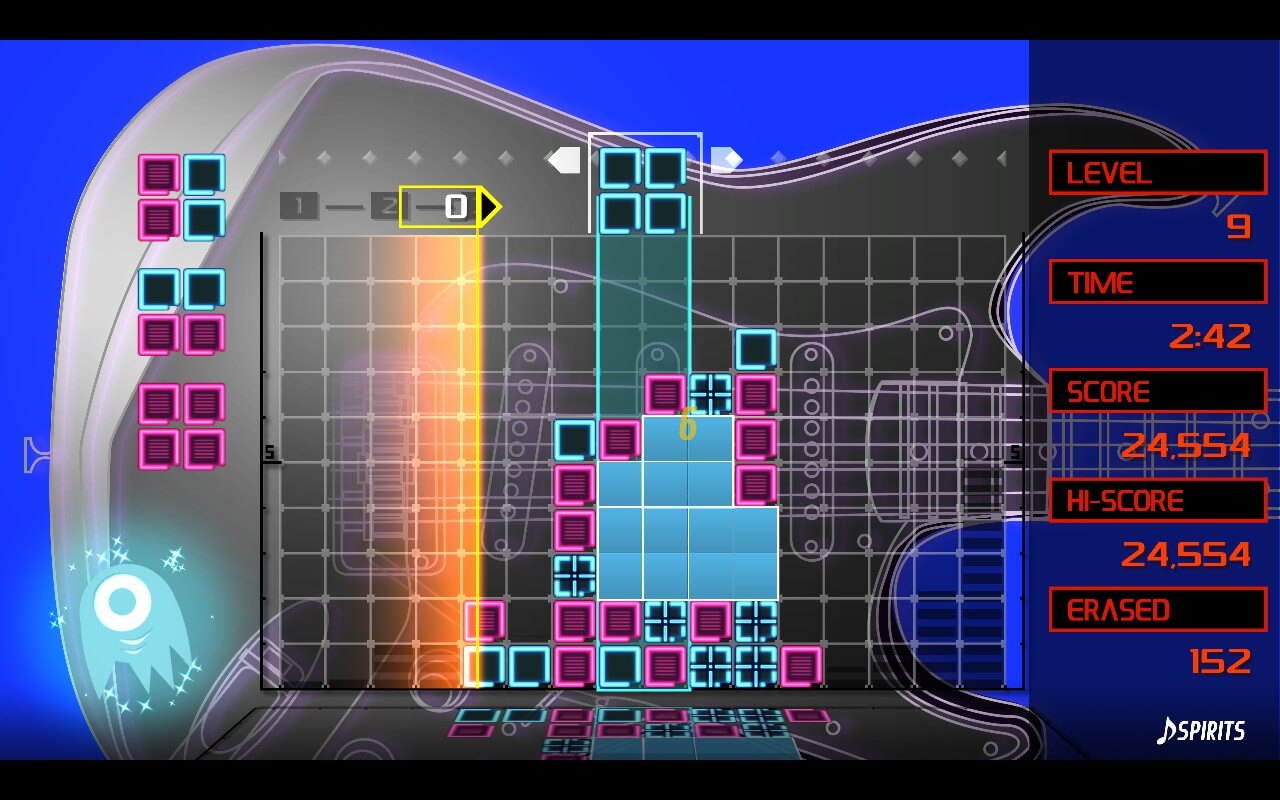
Each stage in Lumines is accompanied
by a unique aesthetic and music track.
In Tetris, gravity is case-dependent, applying only when a tetromino descends and when the line beneath said tetromino is cleared. That's because Tetris is a packing game; tetrominoes falling to the lowest possible point wouldn't offer much in terms of fun factor (not to mention that they'd no longer be tetrominoes). There'd be no place to T-spin! Instead, gravity in Lumines is constant: if the block is in play, so too is gravity.
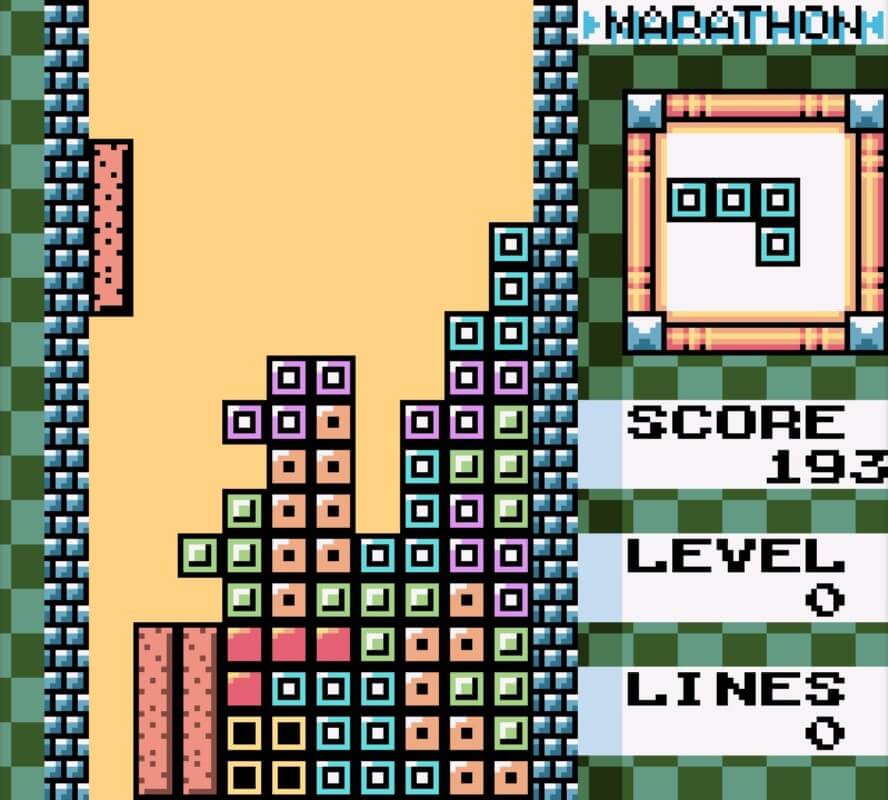
Of the three games, I'm the least familiar with Tetris.
You can probably tell from this screenshot!
Big whoop, you say. Panel de Pon has constant gravity too! And like Lumines, it's a combo-chaining matching game—you make squares/lines, which when cleared drop the blocks above them which can then make squares/lines, which when cleared drop the blocks above them... you see the pattern. And yes, both of those statements are true. But the key distinction is that in Panel de Pon/Tetris Attack/Puzzle League, the blocks enter the playing field—randomly generated—from the bottom, up. The player isn't creating and pruning their own playing field, like in Tetris and Lumines, but instead managing the overgrowth of blocks handed to them. Player agency is reactive, rather than proactive.
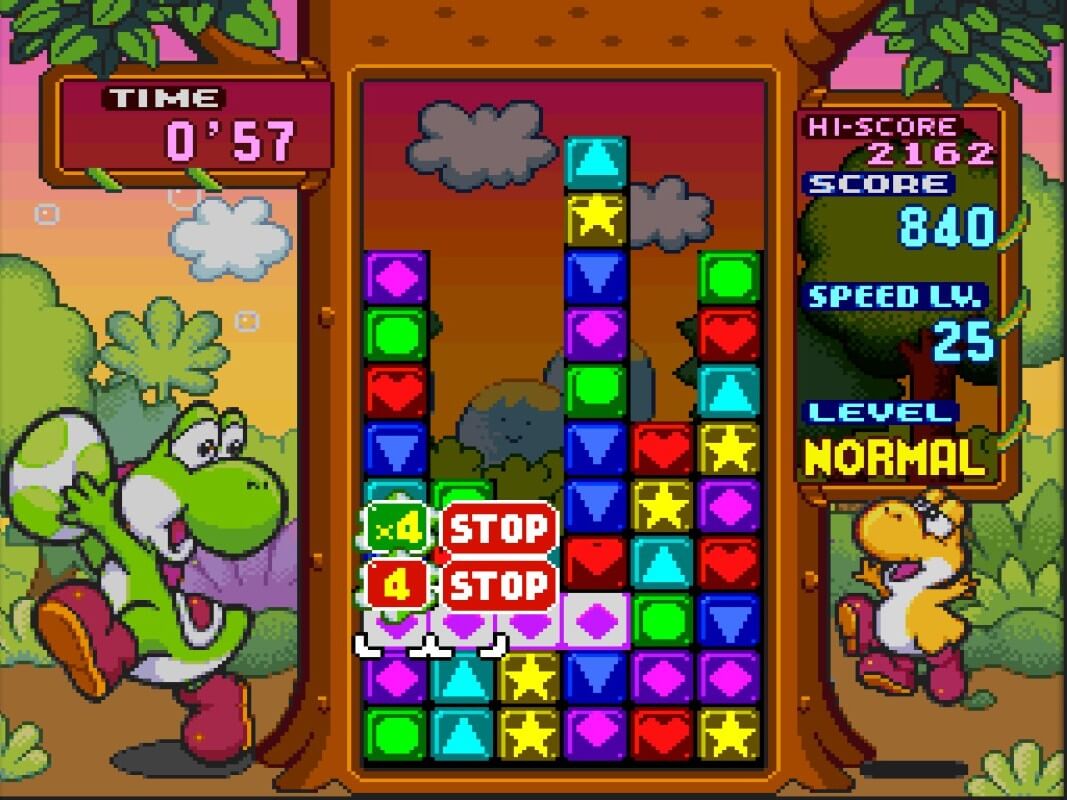
Of the three games, you're most vulnerable to RNG in Panel de Pon
(Tetris Attack seen here).
So Lumines is a proactive game like Tetris, but a combo-chaining matching game, like Panel de Pon. But why is it not like the other girls? What's its back-of-the-box, capital "M" Mechanic?
That would be the metronome. A vertical line sweeps across the screen in time with the music, clearing completed squares as it passes. It meaningfully contextualizes and quantifiably limits the player's "proactivity"—there's a finite scramble to stack blocks as high as possible, to predict where each block will fall and further extend a given combo. Panel de Pon, with its emphasis on "reactivity," limits you by what's on screen. Clear what you can, and you're left twiddling your thumbs as the playing field fills in afresh.** The skill ceiling for Lumines' strain of proactivity is much higher, given that you can control the pace with which you stack blocks between bars *and* prepare for combos several clears in advance.
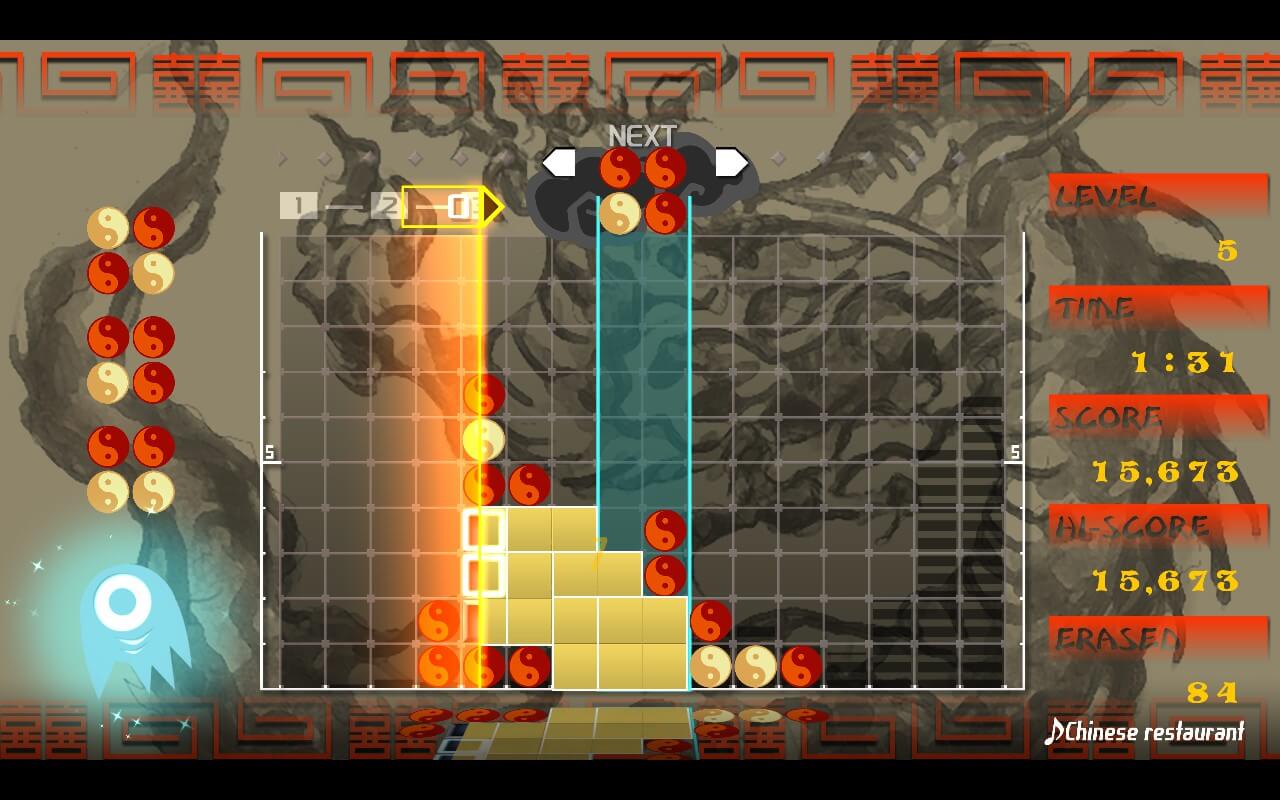
The orange bar is the metronome, seen here erasing blocks.
While the metronome struts about as the featured ingredient, the secret sauce—as alluded to above—remains intuition. Intuition regarding squares, regarding rhythm (e.g. metronome), and, more subtly, regarding gravity. The seasoned player is keenly aware of the blocks in their queue,*** the metronome's tempo, and the latent combos waiting for gravity's catalyst. Yet these considerations are all underpinned by innate, subconscious understandings of shapes, music, and the fact that what's up must eventually come down. That zone between awareness and instinct is the breeding ground for flow states.
Lumines is such a singular concept, and I can't stress enough how the seemingly innocuous decision of constant in-game gravity sets it apart from its peers in spite of a shared design language. It could easily be hand-waved away as another Tetris clone. But small design decisions overwhelmingly contribute to a peerless thesis of flow.
*This is a fascinating article, which in its findings notes that the ability to recognize right angles and parallel sidings is unique to humans and transcends culture and education.
**There is a button that allows you to fill in the screen one row at a time, but it still slows down pacing and reinforces a reactive playstyle.
***I still very much suck at this.