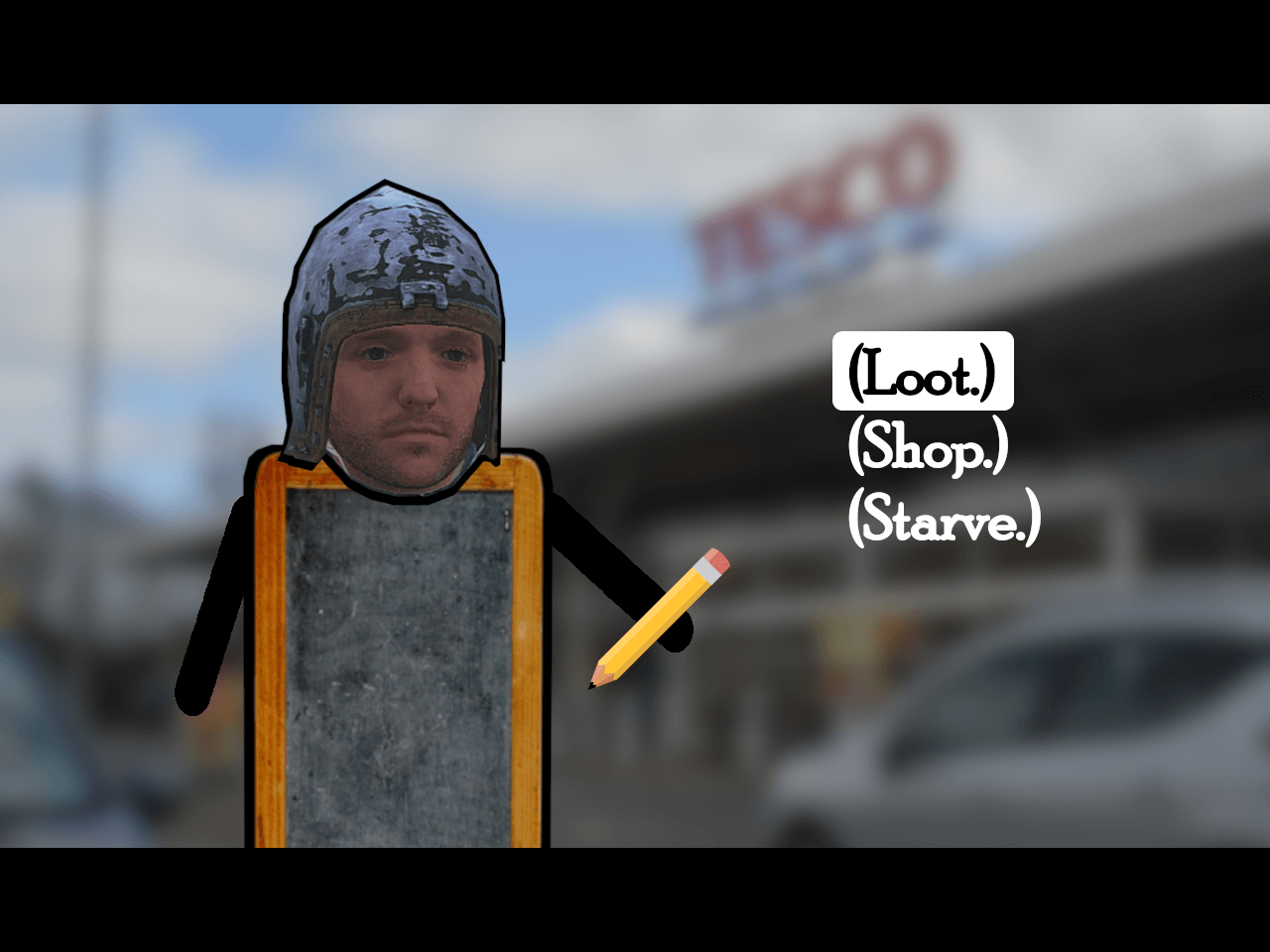
I'm in the process of chipping away at the early game of Kingdom Come: Deliverance (KCD). It's a game that demands attention to its systems and rewards attention to its interpretation of history,* so my progress has been slow.
You play as Henry, the son of a blacksmith in 1403 Bohemia. Things kick off with the murder of Henry's parents at the hands of the invading Hungarian army. He escapes to a nearby town and lays low before returning home to bury his mother and father, driven by Christian duty to honor the dead.
KCD is a choice-driven RPG. Many problems the player faces are open-ended, their respective solutions giving shape to Henry's character and morals. You can bribe, steal, kill, and wreak havoc just as easily as you can uphold the social contract and run everyone's errands like a good RPG boy. NPCs respond to Henry in kind, respecting chivalrous acts and reviling dishonorable ones. Yet that systemic dynamism collapses under the narrative's weight—you WILL be funneled into acting out Henry's escape and return. That rigidity exposes a conflicting approach to role-playing that doesn't quite pan out, at least not in the early game.
On the return trip, as you prepare to lay your parents to rest, you encounter the aftermath of the Hungarian invasion—corpses are strewn across the road, wagon tracks crisscross the blood-soaked earth, and smoldering fire pits denote the invaders' recent encampments. The corpses themselves are laden with goodies. Imperishable foods, valuable clothes, and raw currency are yours for the taking, should you so desire. And desire I did!
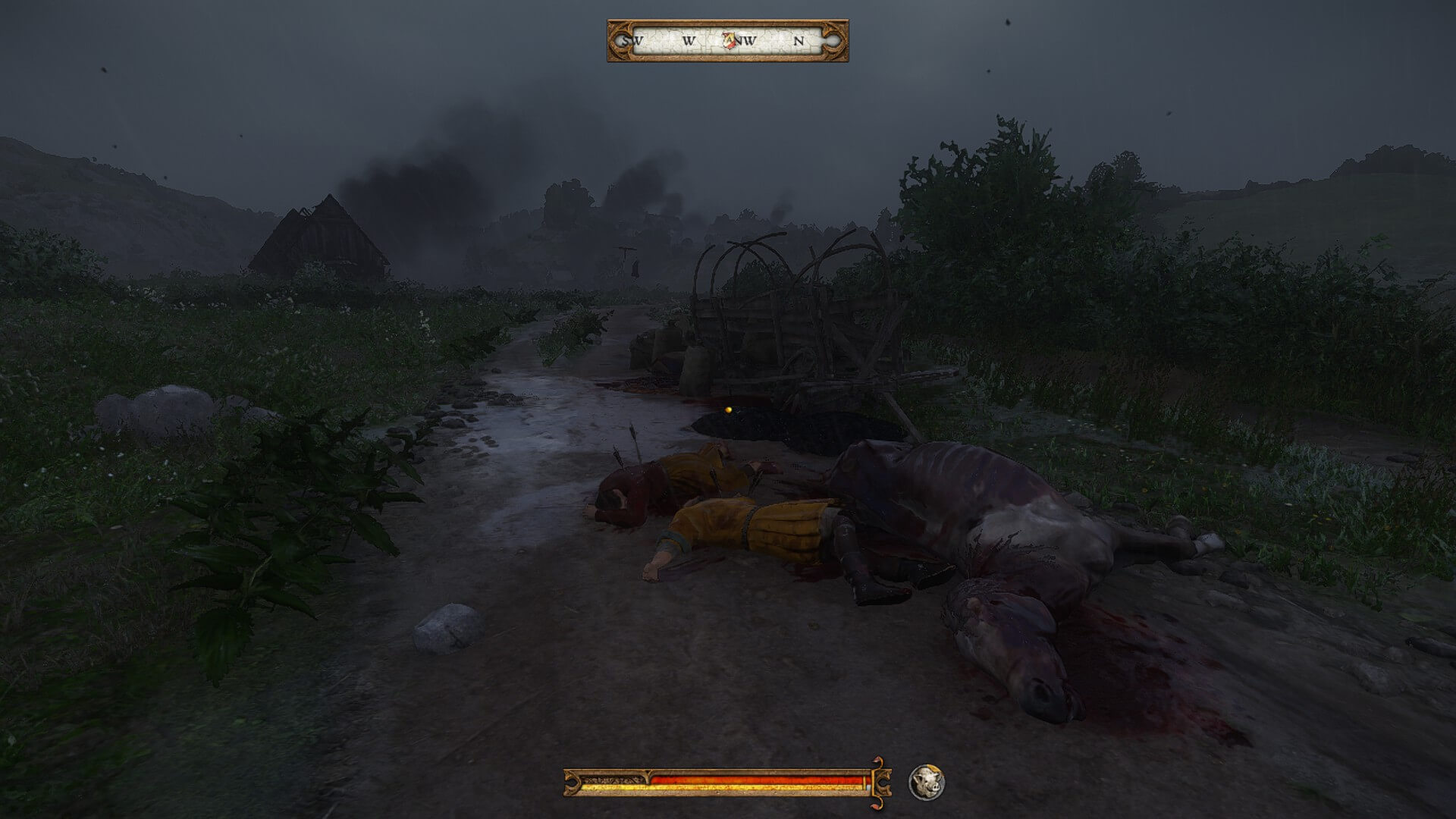
A snapshot from the journey home.
You can't turn off the HUD, oddly enough.
Or rather, I felt pressured to loot. KCD tasks the player with managing their hunger. You can starve. And I, faced with starvation and belly-up Bohemians, acted in favor of my future food/financial security. I stuffed every pocket on my person with apples, bread, and cheese. I pilfered coins, jewelry, and clothing. I wasn't proud of my actions, but I felt justified and was eager to see how they would further define Henry.
They didn't. Upon arriving home, Henry encounters and confronts another looter, chastising him for disrespecting the dead and chasing him out of town, sword in hand. Despite having looted corpses only moments before, there's no indication of guilt or shame (how very un-Catholic), or even recognition of his hypocrisy. It's a dissonant anticlimax that wastes an exciting role-playing opportunity.
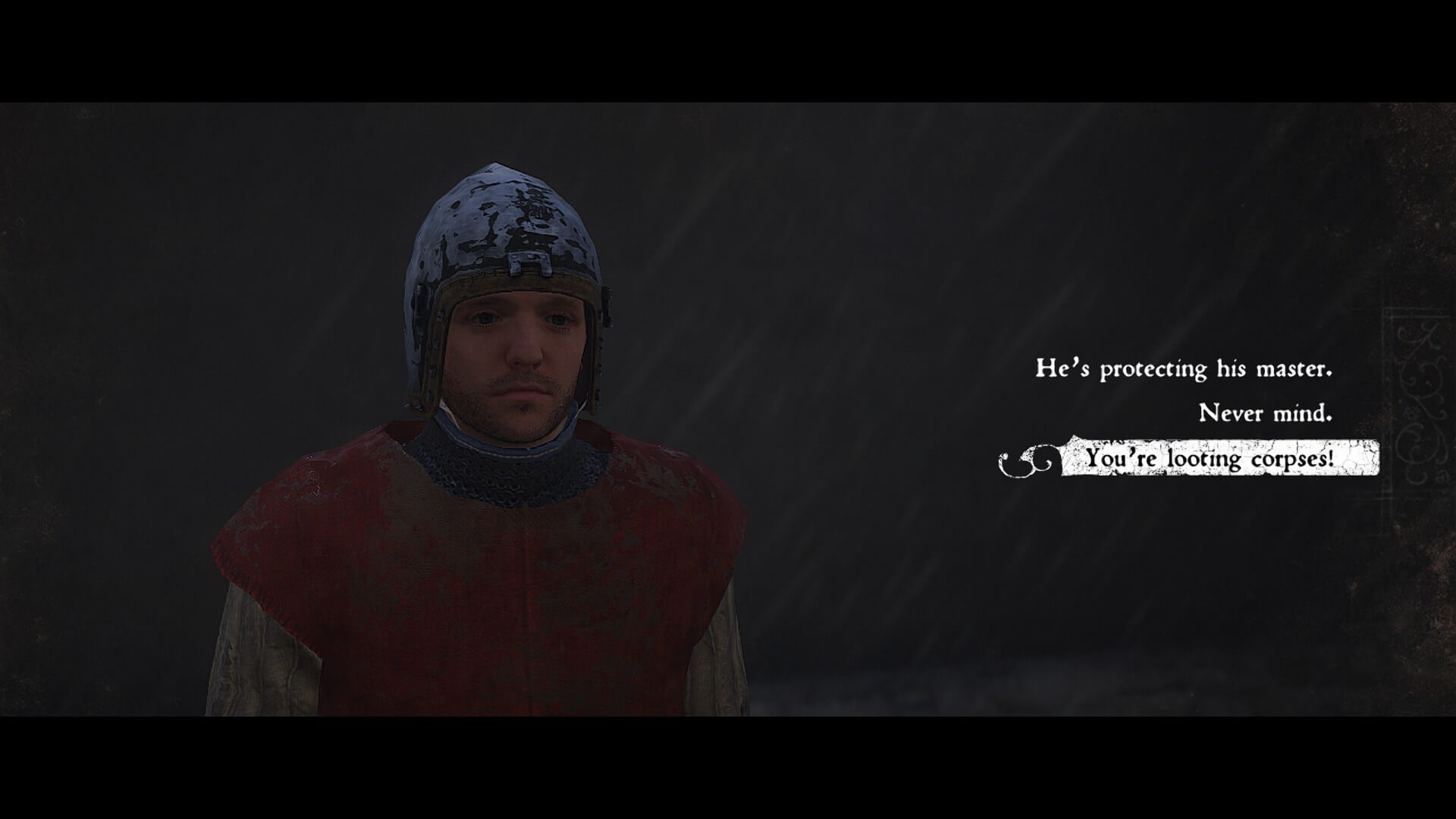
The thick black bars are a little much, in my opinion.
Blending a named character/defined narrative with moral flexibility/choice-driven dialogue is ambitious and destined for messiness, in large part because those ingredients belong to two separate recipes for role-play: role-play as escape and role-play as expression. Escape is to inhabit a prewritten character. Expression is to reflect one's own attitudes and flaws onto a blank slate.
I admire Kingdom Come: Deliverance for facing that messiness head-on and experimenting with both of these recipes. On paper, the former allows for an epic, personal narrative, while the latter vindicates video games as the storytelling medium of choice.** At this point in my playthrough, though, that harmony between recipes has yet to be realized.
But I remain optimistic! Henry is not fully a blank slate. He's written in pencil and subject to change. And for the ambitious design that connotes, I can forgive the smudges.
*KCD may not be a scholarly resource (nor is ANY piece of entertainment), but it is successful at evoking the general period.
**I'm playing through AdHoc's Dispatch at the moment, which operates firmly in the territory of role-play as escape. While I've enjoyed my time, I continue to wonder: "Does this benefit from being a video game?"