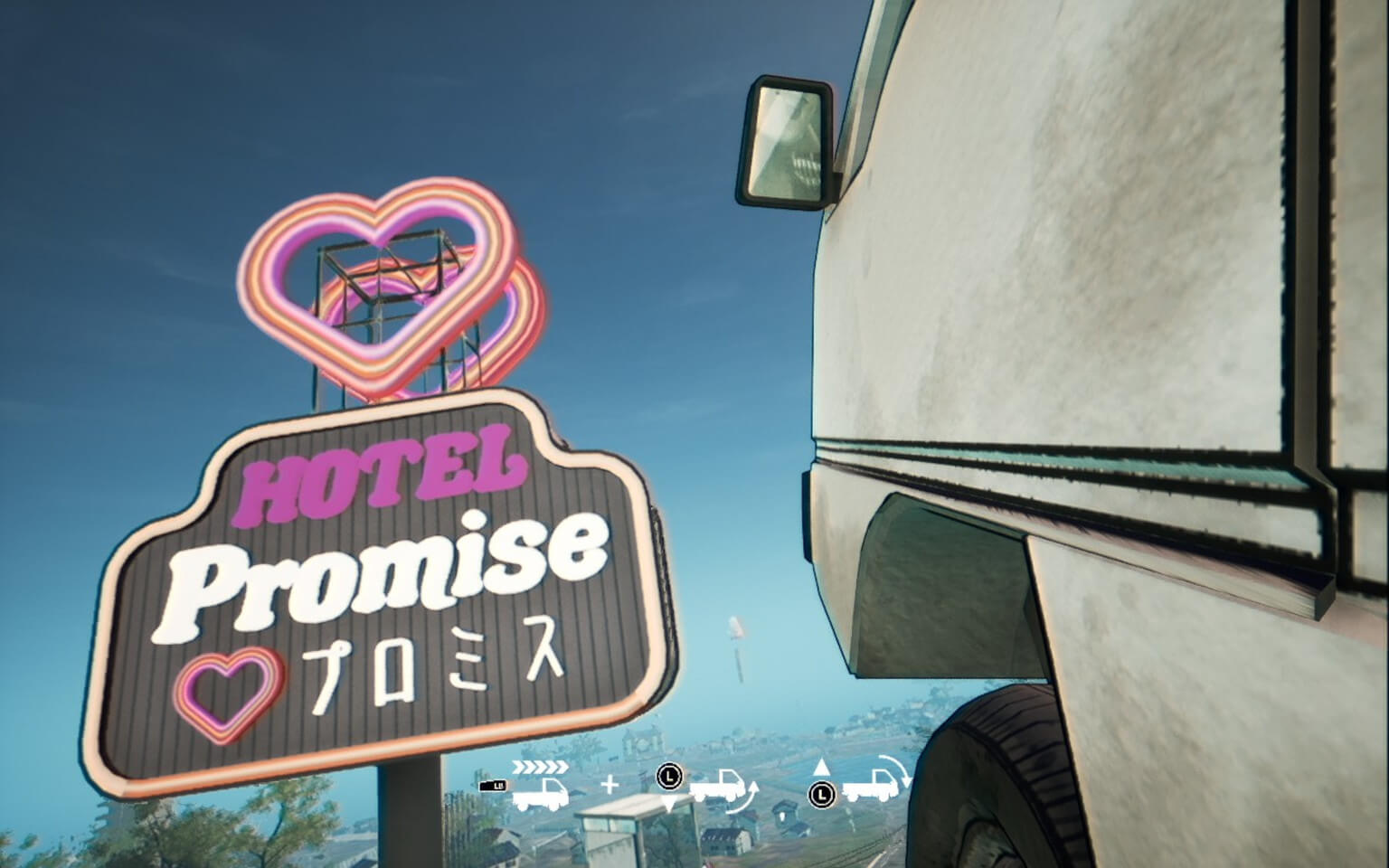
Running a business is hard. Just stand within spitting distance of a business owner and you'll probably hear about their 80-hour work weeks, their strained marriages, their missed piano recitals. While the employee (generally) strives for a sustained, career-long work-life balance, the business owner (generally) strives to front-load their efforts, to eat all their proverbial vegetables first and then gorge on proverbial dessert until the end of their days. Yet that's so rarely the case in real life. If only there were a means of wish fulfillment...
Promise Mascot Agency gives you, a disgraced yakuza banished to podunk Japan, the reins of a fledgling business. You've got to generate cash for your clan by recruiting and leasing out mascots* to various municipal and corporate functions. Fail to send enough money home, and it's game over.
In practice you drive/fly around the island of Kaso-Machi, stumbling across collectibles, NPCs, and the many other distractions littered about. Mascots are managed via a menu where you can assign them to certain jobs and reward them bonuses. These systems are simple enough in and of themselves, but that simplicity doesn't necessarily translate to ease (on Hard Mode**).
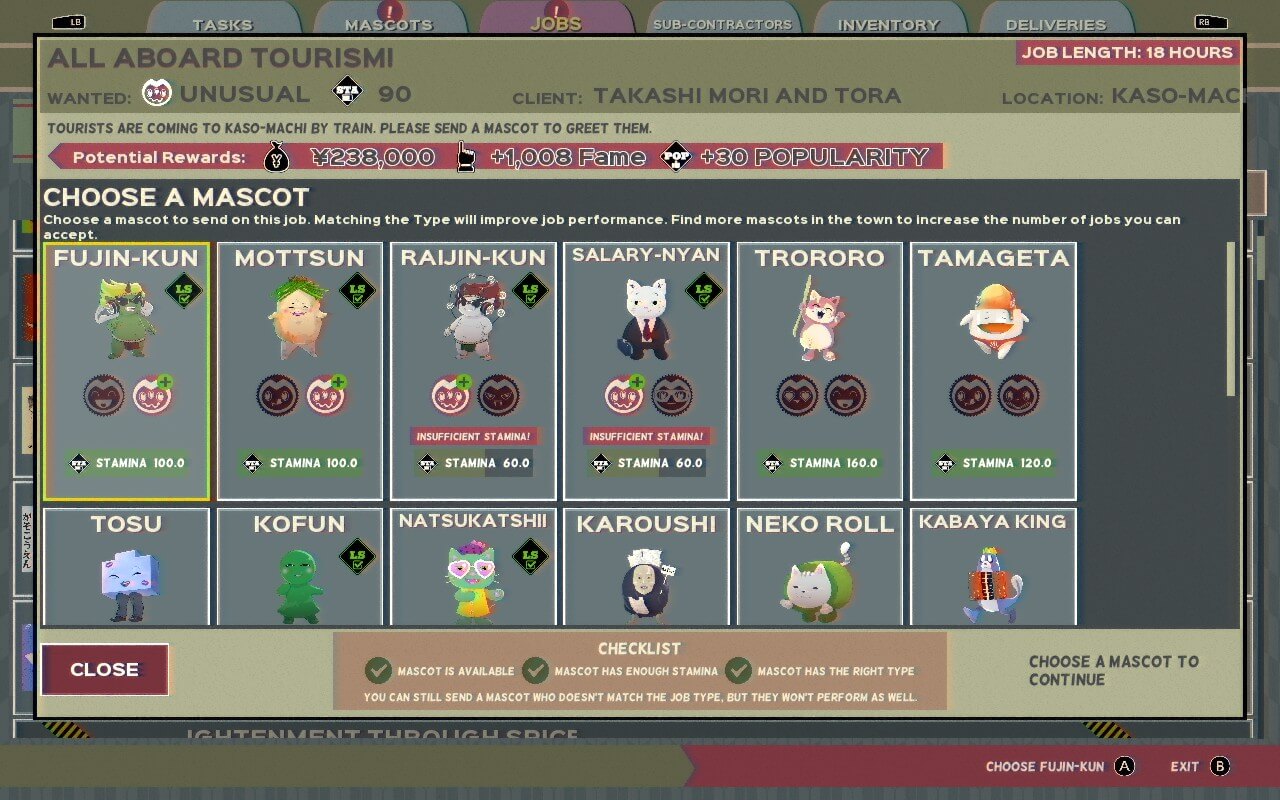
A sampling of the management systems.
Of the 15ish hours I've played, the first eight were nail-biting. I explored very little of the island and completed very few side quests, devoting most of my time to a heated battle against bills and remittances. Under the threat of a game over, there was little choice but to claw my way into the black.
And therein lies the secret sauce—obligation. Kaso-Machi is an open world. I could have gone anywhere, collected anything, and finished any side quest, but I didn't because there were bills to pay and a clan to placate. My desires were in constant competition with my duties.
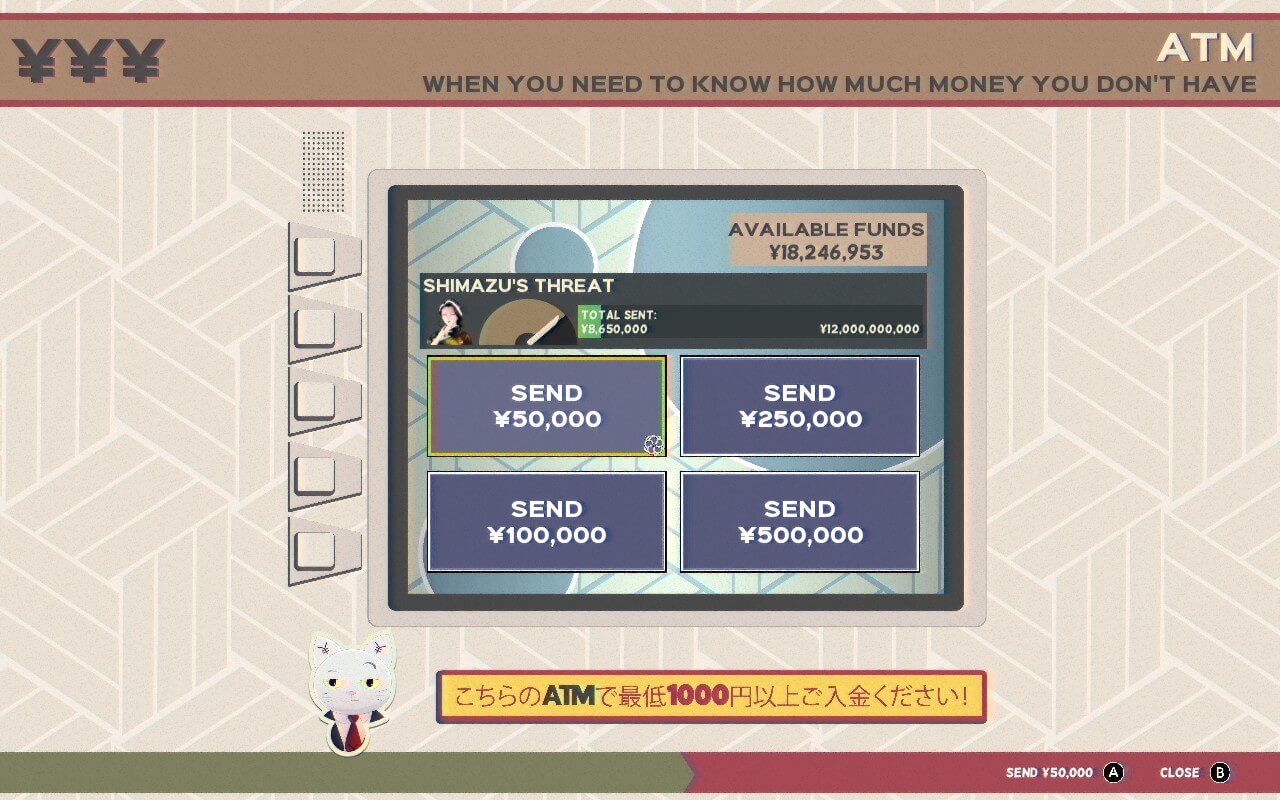
The meter is always ticking down, satiated only by yen.
But bit by bit, my profit margins increased. I hired more mascots, established more contracts, and further diversified my revenue streams. Work, work, work. Eventually, my loyal employees ("They're like family!") and passive income freed up the time to chase after the collectibles and side quests that once taunted me. Play, play, play.
Crucially, that front-loaded difficulty curve parallels the romanticized work-to-play arc of the business owner: you earn your stripes as a long-suffering member of the lower middle class (frugality is a virtue), you receive the recognition you deserved all along (virtue is rewarded), and lastly you exploit the workers beneath you (virtue alone doesn't pay the bills).
Okay, so maybe not that last part. But in the late game you do shunt most of your financial responsibilities to your employees. Money becomes an afterthought, and you get to roam the island at your leisure.
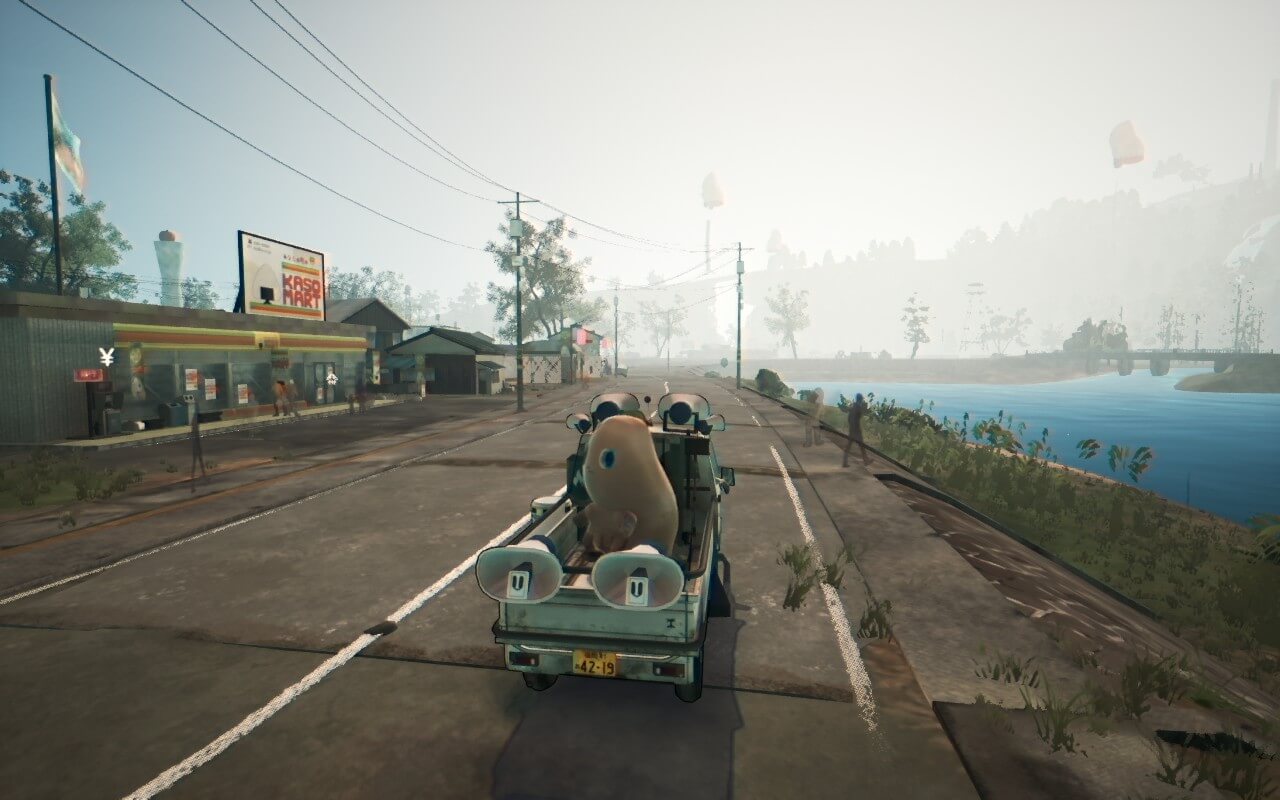
You progress from wheels to wings as you upgrade your vehicle.
Speaking of money as an afterthought, Persona 5 makes for an excellent point of comparison with Promise Mascot Agency: they're both genre mashups (life sim/dungeon crawler vs. management sim/collectathon) attempting to unify those genres via their in-game economies. In my opinion, Persona 5 fails at doing so. Its in-game economy a) allows one genre to outshine the other and b) undermines the role-playing experience.
I say this not to dunk on Persona 5 (and not *only* to plug my post), but to point to where Promise Mascot Agency really shines! The transition of its in-game economy from a leaky faucet in the early game to an open floodgate in the mid-to-late game meaningfully shapes how the management sim and collectathon interact (e.g., obligation) and reinforces the role-playing fantasy of business ownership. It turns out that eating your vegetables first makes dessert taste that much sweeter.
*I don't want to get lost in the weeds re: Japanese mascot culture, so here's a helpful source on the subject.
**I cannot recommend Hard Mode enough! Normal Mode does a disservice to the game's themes and systems (and nullifies my whole argument, haha).