Abandon all self-seriousness, ye who enter here. Hardhat Wombat is all in on the cube-shaped poop of its eponymous critter. Yes, the platformer/puzzle gameplay revolves around eating different materials and "processing" them into the building blocks needed for your construction projects. Expect many a fart sound and poo pun. BUT (a big "but," I'll admit) underneath the premise's inherent juvenility and a ho-hum campaign, there's an ingenious puzzle game that defies convention and delivers a surprisingly deep mechanical experience.
A guiding ethos of modern puzzle design is that the time spent between solving a puzzle mentally and translating that solution through gameplay should be as minimal as possible. Hardhat Wombat is anomalous in that the solutions are already provided for you—translating the solution through gameplay is the entire conceit. In fact the puzzle isn't really the end product, but instead the steps taken to get there.
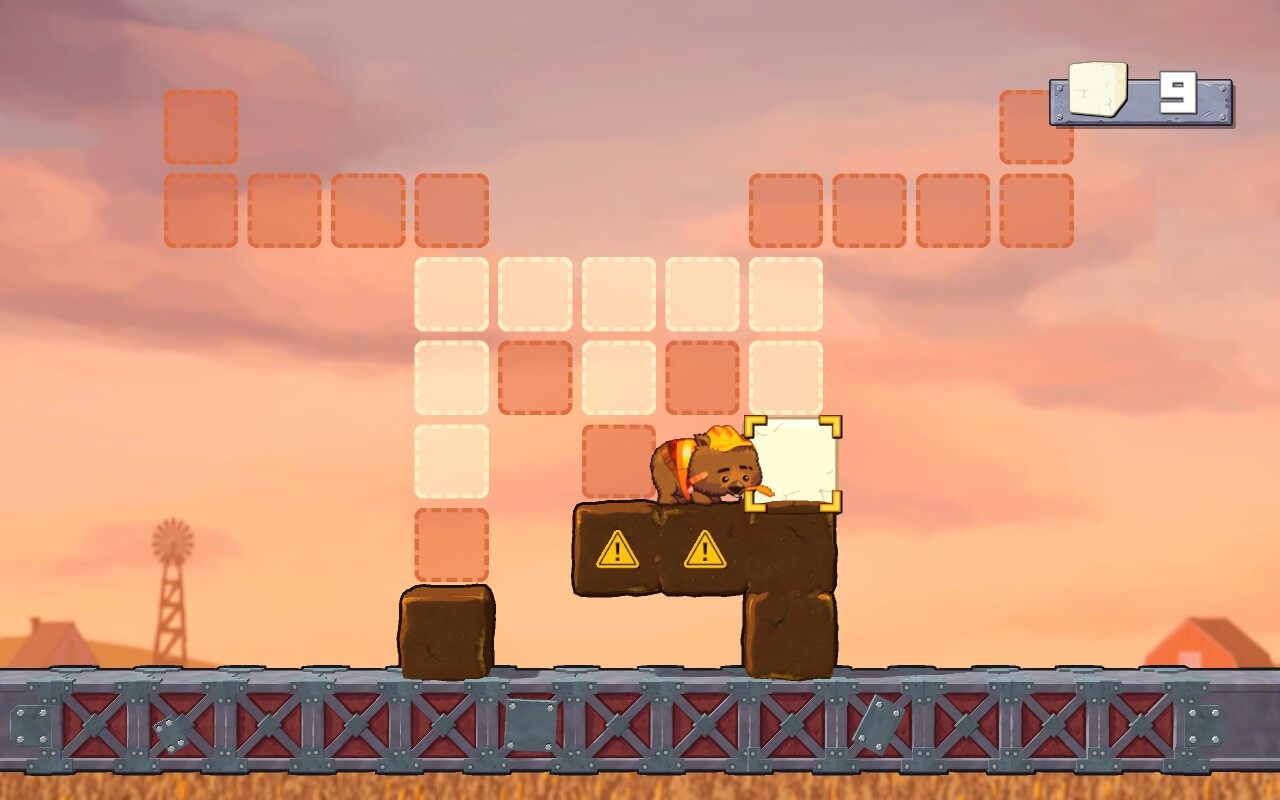
You're provided a "blueprint" of your end goal, as seen above.
That understanding informs the rest of the game's design. The "solutions"—overlaid on the background of each level—are deliberately open-ended, allowing for numerous means of achieving them. You can only carry ten blocks at a time, so you'll have to refill your reserves constantly by walking back to the edges of the level. The blocks themselves and their properties vary, with the ice block melting after a short while, the bubble gum block floating away if unimpeded, and the egg block cracking if stepped on (to name a few). All of these elements are designed not to empower the player, but to hinder them.
And those hindrances, no matter how intentional, make for a tiresome campaign. It gets in your way but doesn't demand anything from you. Its self-explanatory puzzles, limited resources, and lack of a time limit leave little to challenge, thrill, or entice.
Unchallenged, unthrilled, and unenticed, I decided after about 15 minutes that Hardhat Wombat was audiobook fodder. With my attention diverted, I brute-forced my way through each and every level, maintaining a meandering pace that allowed for lots of listening and minimal thinking; after all, the game's expectations of me were so lax that reaching the end was a question of time, rather than ability.
I was woefully unprepared for what awaited me…
Hardhat Wombat's post-game turns up the heat by measuring your ability *against* time. It's a simple change (time trials aren't revolutionary), but one that recontextualizes everything that made the campaign so dull. You must now make on-the-fly assessments of each random level: determining the fastest route to translate the solution, calculating how few trips you can get away with to place the requisite blocks, and ensuring that you haven't boxed yourself in. All of those considerations are present in the campaign but given no weight—the principles of play don't change in the post-game, but the metric of success does.
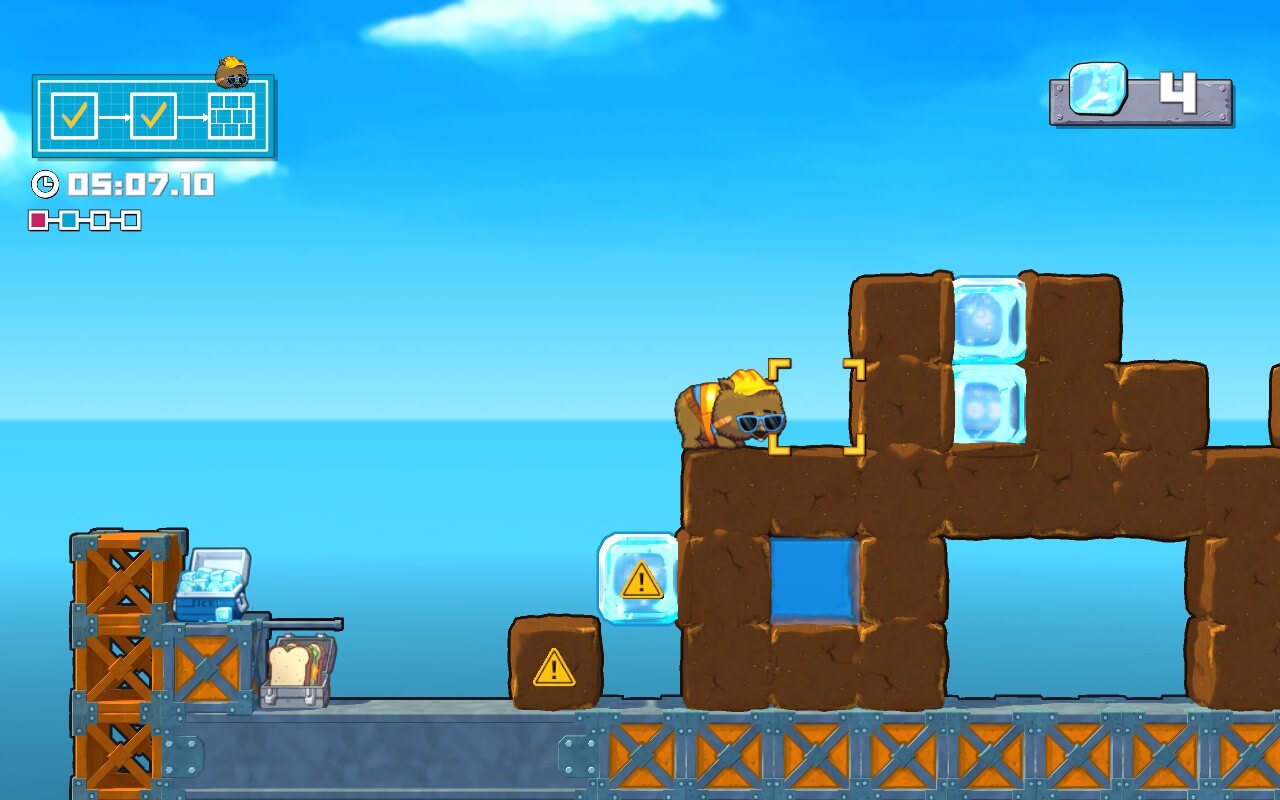
Note the refill lunchboxes on the edge of the level
and the timer in the upper left corner (please).
And it's a ton of fun! Under the threat of the clock (and the promise of leaderboards), Hardhat Wombat's economy of time and movement becomes challenging, thinky, and addictive. The random selection of hand-crafted levels is reminiscent of Spelunky,* in that skill expression isn't through the performance of a routine but through the intimate understanding of systems and their interactions.
I continue to enjoy Hardhat Wombat, and I foresee the daily time trial becoming a quick, go-to brain tickler. But the fact that the best content—daily time trial included—is locked behind a tedious campaign (that doesn't even prepare you for the post-game!) makes the experience a tough one to recommend.
*Andy Hull was a programmer for both Hardhat Wombat and Spelunky HD, interestingly enough.